
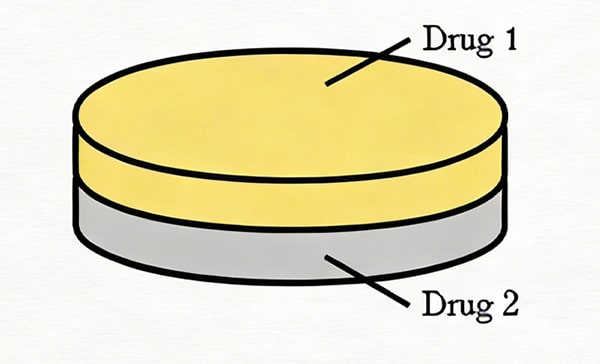
Bilayer tablets (also called two-layer or multi-layer tablets) combine two distinct formulations in one pill. In essence, a bilayer tablet is made by compressing two different powder blends into a single tablet, keeping each blend physically separate in two layers. This design lets manufacturers put two medicines or two release profiles into one pill. Por exemplo, one layer might provide an immediate dose while the other layer delivers a sustained release of the same or another drug. Na prática, a bilayer tablet is like pressing two compatible tablets together so that patients only have to swallow one.
Manufacturing of bilayer tablets occurs in clean, controlled facilities to ensure quality. These unique two-layer tablets are more convenient for patients, since they combine multiple medications (or extended-release and fast-release doses) in one pill – improving patient compliance. Em outras palavras, by layering drugs in one tablet, bilayers can simplify a treatment regimen. This approach allows delivering multiple active ingredients while reducing the total number of pills a patient needs.
Bilayer tablets offer several key advantages in drug delivery and pharmaceutical manufacturing:
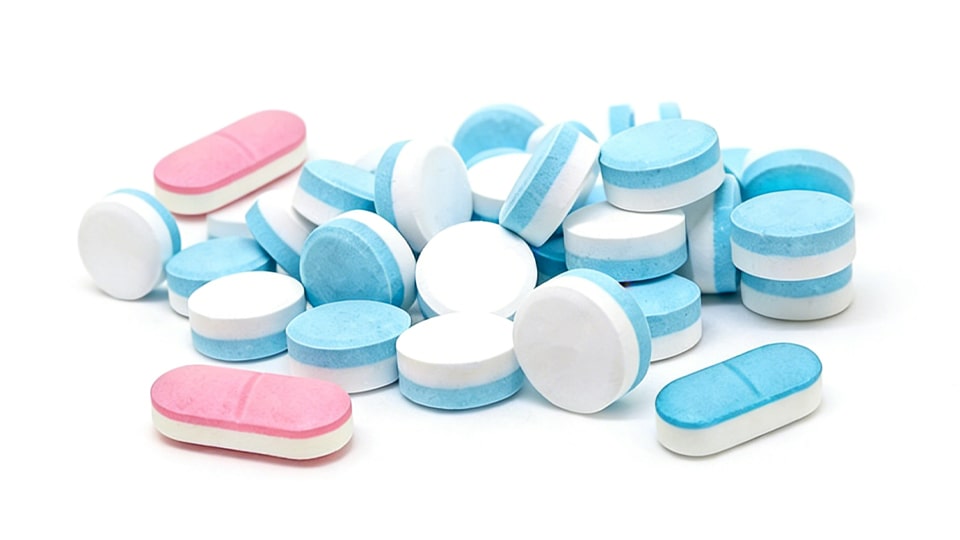
These pill bottles illustrate how bilayer tablets can combine multiple medicines into one dose. Por exemplo, instead of taking two separate pills for morning and evening doses, a single bilayer tablet can be formulated to release a drug immediately (one layer) and then release additional drug later (second layer). This convenience and versatility are why bilayer tablets are called an “integral advancement” in oral drug delivery.
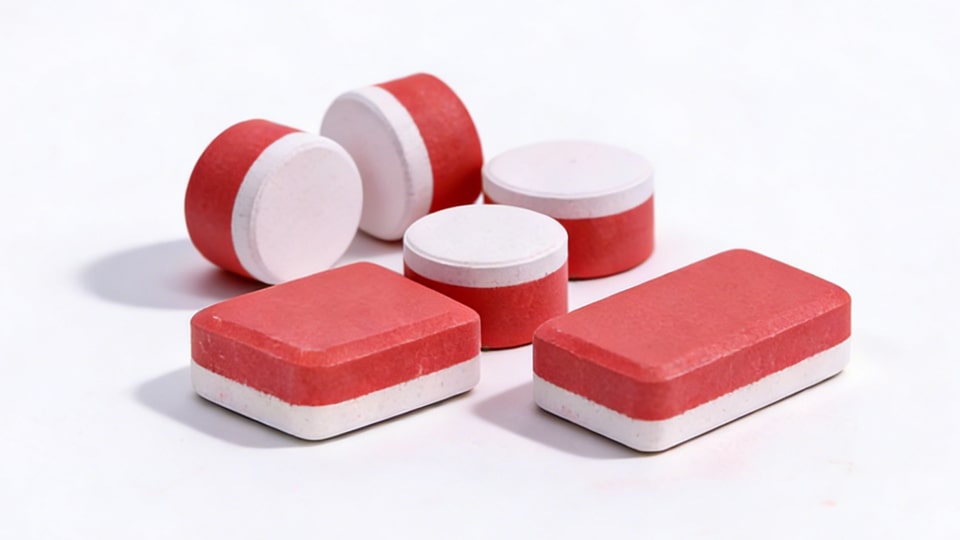
Formulating a bilayer tablet is more complex than a regular single-layer tablet. Think of it as formulating two tablets at once: each layer needs its own granulation (blend of API and excipients) that will compress well and stick together. Key points include:
Resumindo, imagine each layer as its own mini-tablet formulation. You design two compatible “recipes” and then stack them. Getting uniform weight and good bonding requires careful attention to powder flow, tamanho de partícula, and compression settings.
Making bilayer tablets requires a specialized máquina de prensa de comprimidos – often called a multi-layer tablet press or bilayer tablet press. Unlike a normal tablet press with a single hopper, a bilayer press typically has two hoppers and feed frames. Here’s how it works:
A rotary multi-layer tablet press has a die cavity that passes beneath two (ou mais) hoppers in sequence. The first hopper drops the granulation for layer 1 into the die; the machine partially compresses it. Então, as the turret turns, the second hopper adds the granulation for layer 2 on top of the first layer. Finalmente, the press applies the main compression to fuse the layers into a single tablet. This dual-hopper system ensures each layer stays separate until final compaction.
Modern multi-layer tablet presses are very high-speed. Por exemplo, laboratory-scale bilayer presses might run at 8,000–20,000 tablets per hour, while commercial-scale presses can produce up to roughly 600,000 comprimidos por hora. These machines include electronic controls for punch displacement and force, allowing tight control of each layer’s weight. Notable equipment manufacturers (como Jinlupacking, Korsch, Fette, Kilian, Courtoy, etc.) have developed presses with features like sealed feeders, pre-compression rolls, and weight sensors to address bilayer-specific challenges.
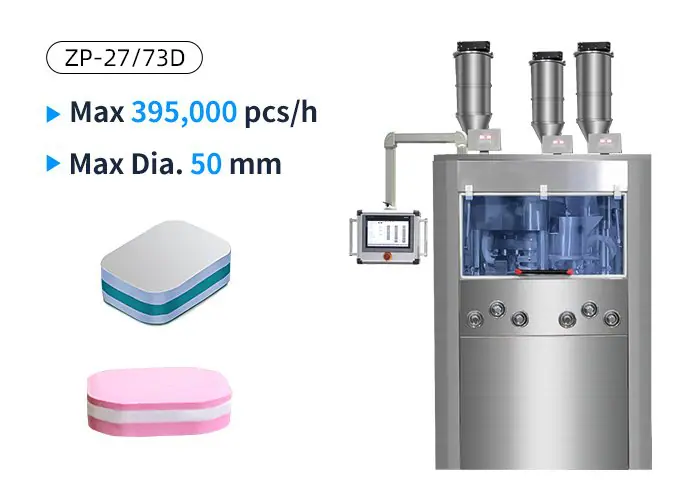
Brief Equipment Example – Jinlu Packing’s ZP-27/73D: As a real-world example, Jinlu Packing’s ZP-27/73D Multi Layer Tablet Press is designed for exactly these tasks. It’s a three-layer-capable machine (ou seja. it can even make tri-layer tablets) and boasts an output up to 395,000 comprimidos/hora. This press can produce large tablets (até 50 mm diameter) e, with custom tooling, can make various shapes – from effervescent and ball tablets to two-color or three-layer designs. Its robust construction (E.G.. a nodular cast iron turntable) atende aos padrões cGMP, and it uses a special force-feeding system to handle sticky materials. Resumidamente, equipment like this ensures the complex layering process runs smoothly in production.
The basic steps to manufacture a bilayer tablet are:
Throughout this cycle, the press must precisely control die fill and compression for each layer. Modern presses often have sensors to monitor layer weight and turret speed in real time. This ensures each layer is filled correctly and each tablet is consistent. By carefully synchronizing the hoppers and punches, the machine fuses the layers without mixing them. The key is that partial compression of the first layer creates a foundation for the second layer to adhere properly.
[jl_youtube src=”https://www.youtube.com/embed/w0QdN2TGbiw”]
Em produção, continuous monitoring is essential. Por exemplo, if too much powder is metered from the second hopper, the top layer can become too thick, throwing off dosage. Many high-end tablet presses automatically adjust fill depth and force on the fly to keep layers uniform.
Bilayer tablet manufacturing comes with special challenges:
Resumidamente, successful bilayer production demands careful control at every step. With the right equipment and expertise, these challenges can be overcome. As AbbVie notes, state-of-the-art equipment, thorough formulation work, and process optimization are key to commercializing bilayers.
When it comes to choosing machinery, reliability is crucial. Jinlu Packing is a trusted manufacturer of tablet presses and other pharma equipment. Our ZP-27/73D Multi Layer Tablet Press is specifically engineered for complex dosage forms. It uses high-quality materials and precise engineering – for example, a wear-resistant cast-iron turret that meets GMP standards and a special force feeder to handle sticky blends. Jinlu also offers comprehensive after-sales support (comissionamento, treinamento, peças de reposição) so production runs smoothly long-term. Em outras palavras, as you look to implement bilayer tableting, you can count on equipment like Jinlu’s to meet the demands of high-speed, multi-layer production.
Bilayer tablets open up creative possibilities in oral drug delivery. By packaging two formulations in one tablet, you can improve patient convenience, optimize release profiles, and combine medications that would otherwise be hard to pair. Making bilayer tablets involves careful formulation and specialized equipment, but the payoff is significant. You’ll need dual-hopper tablet presses (like Jinlu Packing’s ZP-27/73D) and a well-planned process, but the result is a reliable, high-quality dosage form. With the right strategy and machinery, bilayer tablet manufacturing can be seamlessly integrated into modern pharmaceutical production lines.
A bilayer tablet is a compressed oral dosage form that contains two distinct layers of powder, each with its own formulation. These layers are compressed together into a single tablet, allowing different release profiles or multiple active ingredients in one pill.
Bilayer tablets can combine two active ingredients, provide different release profiles (Por exemplo, immediate and sustained release), improve patient compliance by reducing pill burden, and help physically separate incompatible drugs.
A single-layer tablet contains only one formulation compressed at once. A bilayer tablet has two separate layers, each with its own formulation and properties, requiring specialized compression and manufacturing techniques.
A bilayer tablet compression machine has dual hoppers and feeders. It fills and compresses each layer separately before fusing them into a single tablet. This equipment ensures accurate dosing and strong interlayer bonding during manufacturing.
Key challenges include layer adhesion issues, variação de peso, cross-contamination between layers, and differences in material compressibility. Careful formulation and optimized machine parameters help address these challenges.
The bilayer manufacturing process includes:
1.Preparing two separate granulations;
2.Filling and lightly compressing the first layer;
3.Filling the second layer on top;
4.Applying final compression to fuse layers;
5.Ejecting and inspecting the finished tablet.
Critical formulation factors include powder flow, excipient compatibility, layer adhesion, particle size distribution, and compression force settings to ensure consistent quality and structural integrity.
Quality controls focus on uniform weight, dureza, layer integrity (no delamination), content uniformity, and adherence to manufacturing standards. Regular testing minimizes defects.
Sim. A bilayer tablet can physically separate incompatible ingredients into different layers. This prevents direct contact while still delivering both drugs in one dosage form.
Bilayer tablets are widely used in pharmaceutical manufacturing, nutracêuticos, and therapy combinations requiring customized release profiles or multi-drug delivery in one tablet.
Referências:
1.A Review on Bilayer Tablet Technology – Biblioteca Nacional de Medicina
2.A Review on Bilayer Tablets and Its Technology – International Journal of Pharmacy and Pharmaceutical Research
3.Bilayer tablets: A developing novel drug delivery system – Ciência Direta
4.Comprehensive Reviews on Bilayer Tablet Formulation Issues – WJPS Online