
Pharmaceutical excipients are the “inactive” ingredients that make medicines work. सामान्य शर्तों में, a pharmaceutical excipient is any substance other than the active pharmaceutical ingredient (एपीआई) that is intentionally included in a drug formulation. These excipients help shape the final medication – they give tablets their size and form, suspend ingredients in syrups, thicken creams, स्थिरता में सुधार, और make pills safe to swallow. While excipients themselves have no therapeutic effect, they play vital supporting roles. वास्तव में, nearly every commercial drug contains excipients, often more by weight than the API. Think of them as essential helpers behind the scenes: without the right excipients, a medication wouldn’t hold together, dissolve properly, or meet safety standards.
Excipients come from many sources – common examples include sugars (like lactose, sucrose), starches, सेलूलोज़ डेरिवेटिव, polymers (उदाहरण के लिए:. polyvinylpyrrolidone or polyethylene glycol), and even water or oils. परिभाषा से, excipients must be carefully tested and pharmacopeial-grade. They are evaluated for safety and purity just like APIs. व्यवहार में, excipients should be inert and non-reactive, but they can have active effects (उदाहरण के लिए, some help drugs dissolve or stabilize them). Broadly, excipients are chosen to aid manufacturing and improve the drug’s performance without acting as medicine themselves.
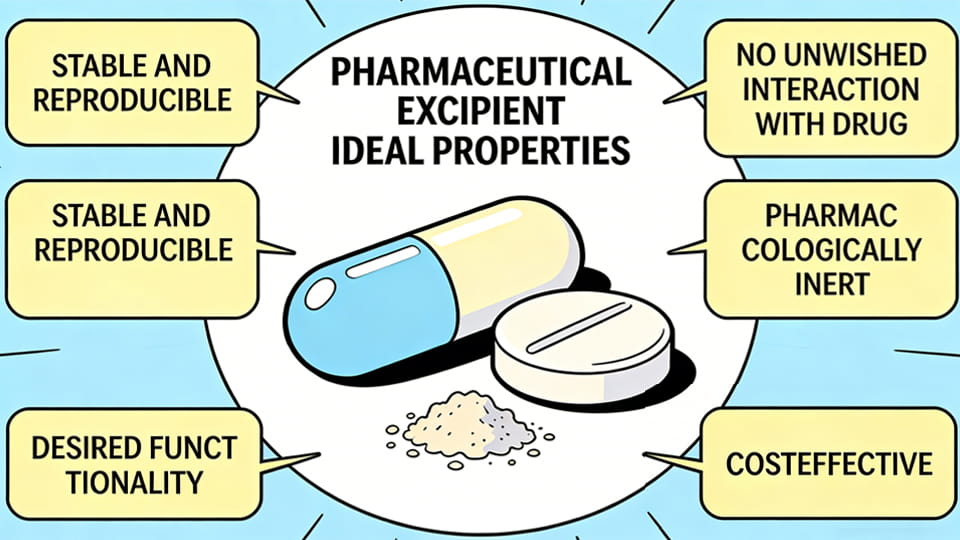
आकृति: Ideal properties of pharmaceutical excipients. An ideal excipient is stable, सुरक्षित, अक्रिय, functional (performs its role well), and cost-effective. In reality, excipients vary from very simple natural substances to engineered polymers. They must be compatible with the API and dosage form. उदाहरण के लिए, some excipients improve a drug’s solubility or absorption, control viscosity, or protect the active ingredient from moisture or degradation. Modern excipient design balances these qualities: they need to be pharma-grade (meeting USP, Ph. Eur., JP standards) and produced under GMP conditions.
Excipients perform multiple critical functions in a drug product:
In plain language, excipients are the “stagehands” of a medication. You don’t see their effect as you take a pill, but the medicine wouldn’t work without them. उदाहरण के लिए, an excipient may act as a binder to hold tablet ingredients together or as a glidant to improve powder flow into the tablet press. These functions are crucial. Without disintegrants, a tablet might not dissolve properly; without lubricants, tablets could stick to the press machinery; without stabilizers, a medicine could spoil before reaching patients.
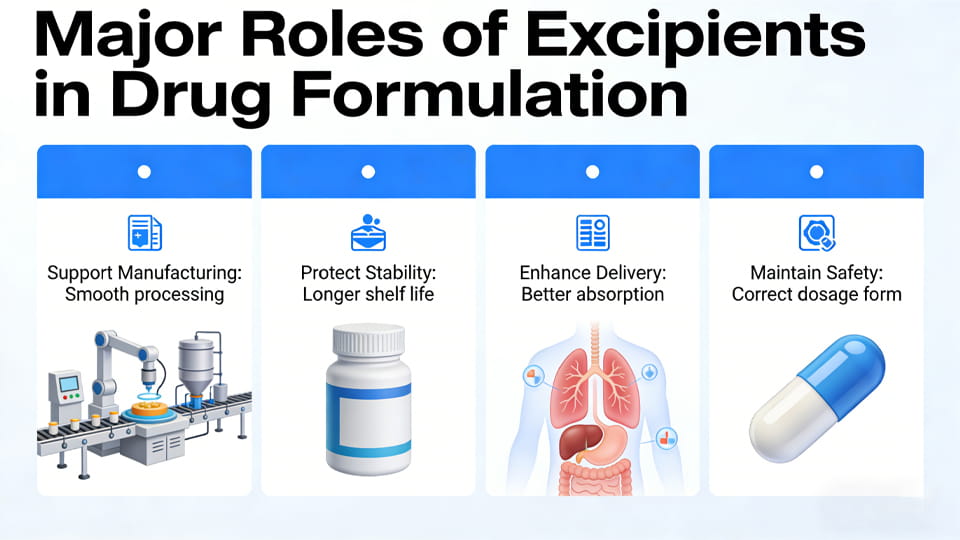
आकृति: Major roles of excipients in a drug formulation. Excipients support manufacturing (smooth processing), protect stability (लंबी शैल्फ जीवन), enhance delivery (better absorption), and maintain safety (correct dosage form). Each excipient is chosen for one or more of these roles.
Pharmaceutical excipients are often categorized by their function or by the dosage form they support. Below is a quick reference table of common excipient categories, what they do, and examples of each:
| वर्ग | Primary Function | उदाहरण |
|---|---|---|
| फिलर्स / Diluents | Add bulk to formulations, especially when the API dose is small. | लैक्टोज, माइक्रोक्रिस्टलाइन सेलुलोज, स्टार्च |
| बाइंडर | Hold the tablet or granules together. | Polyvinylpyrrolidone (पीवीपी), hydroxypropyl cellulose, स्टार्च |
| विघटित | Help tablets/capsules break apart (disperse) when in contact with liquid. | Croscarmellose sodium, sodium starch glycolate (SSG), corn starch |
| स्नेहक | Reduce friction in tablet presses or capsule machines to prevent sticking. | Magnesium stearate, stearic acid, talc |
| फिसलन नृत्य | Improve powder flow properties during manufacturing. | Colloidal silicon dioxide, talc |
| Coating agents | Form a protective or functional film on tablets. | हायड्रोक्सीप्रोपायल मिथायलसेलुलॉज (एचपीएमसी), ethylcellulose, shellac |
| संरक्षक | Prevent microbial growth in liquids/creams. | Sodium benzoate, parabens (methylparaben), sorbic acid |
| विलायक (तरल पदार्थ) | Dissolve or suspend ingredients in liquid forms. | शुद्ध पानी, ethanol, ग्लिसरीन |
| Thickeners (liquids/semisolids) | Increase viscosity, stabilize suspensions or gels. | Methylcellulose, carbomer, xanthan gum |
| Emulsifiers | Stabilize oil/water mixtures in creams/ointments. | Lecithin, polysorbates, cetostearyl alcohol |
| Humectants | Retain moisture in formulations (उदा।, क्रीम). | ग्लिसरीन, propylene glycol, sorbitol |
| Colorants & जायके | Improve appearance and taste for better compliance. | रंजातु डाइऑक्साइड (white colorant), food dyes, sucrose, फलों का स्वाद |
Each drug formulation uses a subset of these depending on its form. उदाहरण के लिए, a tablet may contain fillers, बाँधने, विघटित, स्नेहक, and a coating. A liquid syrup will use solvents (पानी), मिठास, संरक्षक, and viscosity modifiers. A cream or gel includes emulsifiers, thickeners, and humectants.
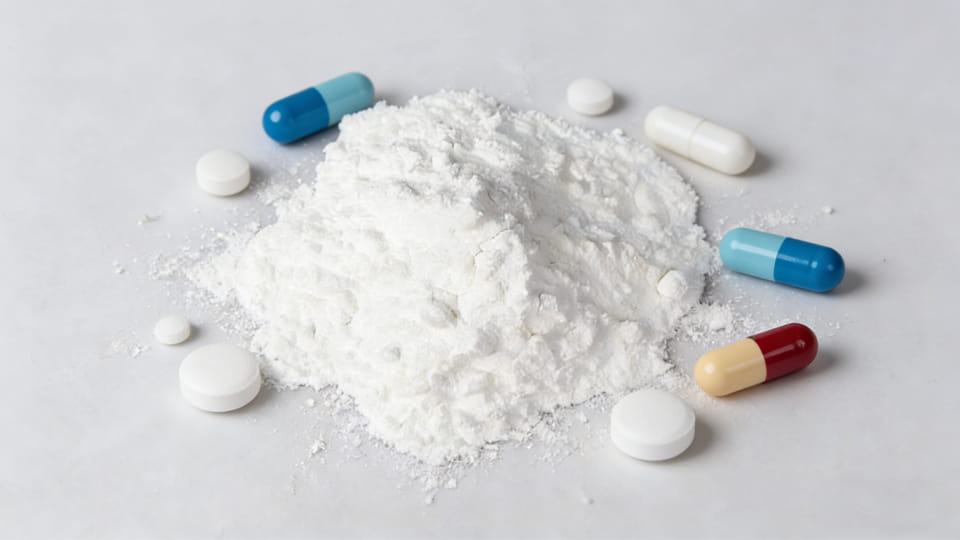
Different dosage forms require specific excipients:
This breakdown shows how excipients are tailored to the form. For every pill, सिरप, or cream, the right “inactive” ingredients make it possible to manufacture, इकट्ठा करना, and use that product effectively.
विनिर्माण क्षेत्र में, excipients and equipment go hand-in-hand. उदाहरण के लिए, once the powder blend of API plus excipients is ready, a tablet press machine (sometimes called a pill maker) compresses it into tablets. Modern pill maker machines, from small tabletop presses to large rotary tablet presses, are engineered for precision: they apply adjustable pressure to form tablets of uniform weight and hardness. High-quality machines are made of stainless steel (साफ़ करना आसान) and comply with GMP standards. The right combination of excipients (फिलर्स, बाँधने, स्नेहक, वगैरह।) ensures these machines run smoothly. उदाहरण के लिए, without sufficient lubricant (मैग्नीशियम स्टीयरेट की तरह), powder may stick to the punch faces and jam the tablet press.
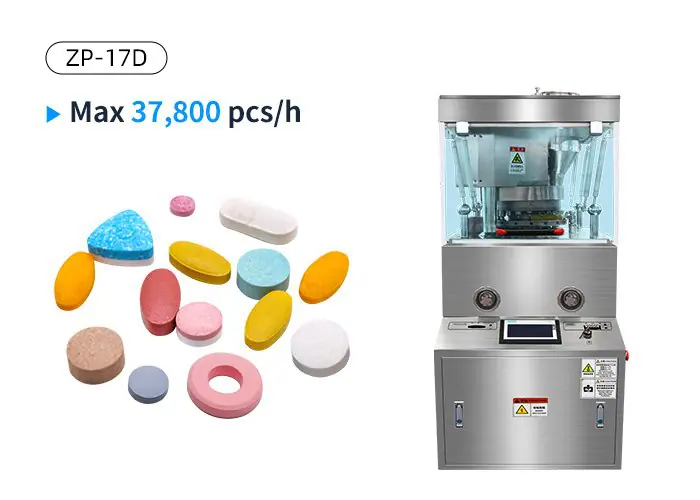
आकृति: Automated tablet press compressing powders into tablets. टेबलेट प्रेस (pill maker machines) combine the API and excipients into firm tablets. The design of these machines (often with computer controls) and use of proper excipients ensures each tablet has consistent weight and dissolution.
उसी प्रकार, कैप्सूल भरने वाली मशीनें are used when the dosage form is a capsule. These machines automatically fill empty gelatin or HPMC capsules with precise doses of powdered ingredients. औद्योगिक उत्पादन में, capsule fillers work at high speed and accuracy. A capsule filler is literally “a type of machine used to fill empty capsules with pharmaceutical ingredients,” combining APIs with excipients to create each dose. Manufacturers may use manual, अर्द्ध स्वचालित, or fully automatic capsule-filling equipment depending on their output needs. Across the board, excipients like fillers and lubricants are carefully selected so that the powder flows and fills the capsule uniformly. The synergy between formulation and machinery is critical – good excipients make production efficient, while good equipment ensures product quality.
Because excipients comprise most of a drug’s mass (often 50–90%), their quality is vital. Regulatory bodies and pharmacopeias (उदाहरण के लिए:. खासियत, Ph. Eur., JP) require that every ingredient in a medication be identified and tested for safety. This means excipients must meet strict standards: they are designated pharmaceutical grade and manufactured under Good Manufacturing Practice (जीएमपी) स्थितियाँ. व्यवहार में, this involves detailed specifications for purity, microbial limits, and absence of contaminants. The sourcing of excipients is also closely monitored – global companies often audit suppliers to ensure consistent quality across batches. जैसा कि एक उद्योग विशेषज्ञ नोट करता है, “Quality assurance in sourcing and using excipients is paramount. Companies need to ensure that these substances meet all regulatory standards for safety and efficacy.”
Excipients can also have regulatory impacts on the final product. उदाहरण के लिए, if an excipient causes an unexpected interaction or allergy, that could trigger additional safety reviews. इसलिए, formulators prefer well-characterized, proven excipients. Many regulatory filings now include detailed profiles of each excipient, including its functional role and any relevant testing.
The field of excipients is evolving. Traditional excipients (शर्करा, सेल्यूलोज, mineral salts) are still ubiquitous, but new “functional excipients” are emerging. These advanced ingredients might carry the API (like certain lipids or cyclodextrins for improved delivery), or respond to triggers (पीएच, तापमान) नियंत्रित रिहाई के लिए. Personalized medicine also demands novel excipients: उदाहरण के लिए, tailor-made polymers for 3D-printed pills or biocompatible materials for injectables. Nanotechnology is another frontier; nanoscale carriers often blur the line between “excipient” and “drug delivery system,” but still rely on excipients to stabilize nanoparticles. The overall goal remains the same: enable better, safer, more effective medications. As one review puts it, excipients are indispensable in ensuring “the safety, effectiveness, and quality of medications,” and their importance will only grow as drug technology advances.
सारांश, a pharmaceutical excipient is any non-active ingredient in a drug that helps make it into an effective, safe product. Excipients are carefully chosen for each formulation – whether a tablet, कैप्सूल, तरल, or cream – to improve manufacturability, स्थिरता, और रोगी का अनुभव. They enable pills and capsules to be formed by machines like tablet presses and capsule fillers. For pharma professionals (इंजीनियरों, buyers, निर्माताओं), understanding excipients means knowing what makes a good formulation and how to meet global standards.
If you’re planning a new formulation or upgrading your production line, remember to consider excipient selection alongside equipment. Need help with equipment or formulations? Our team is ready to assist. Contact Jinlu Packaging today for a quote on high-quality tablet presses, कैप्सूल भरने वाली मशीनें, and complete pharmaceutical production solutions.
A pharmaceutical excipient is any substance in a drug product that is not the active pharmaceutical ingredient (एपीआई). These ingredients are added to support the formulation, स्थिरता, विनिर्माण प्रक्रिया, and usability of the medicine. Excipients help create tablets, कैप्सूल, तरल पदार्थ, or creams that are safe, स्थिर, and easy for patients to take.
Pharmaceutical excipients play several critical roles in pharma manufacturing. They improve powder flow, help tablets maintain their shape, enhance drug stability, and ensure consistent dosing. Without excipients, many APIs could not be processed into practical dosage forms like tablets or capsules.
Some common examples of excipients include:
• Lactose (filler or diluent)
• Microcrystalline cellulose (बांधनेवाला)
• Magnesium stearate (चिकनाई)
• Croscarmellose sodium (disintegrant)
• Hydroxypropyl methylcellulose (टैबलेट कोटिंग)
• Sodium benzoate (preservative)
These ingredients support formulation stability, manufacturability, and patient acceptability.
Typical excipients used in tablet formulation include:
• Fillers or diluents
• Binders
• Disintegrants
• Lubricants
• Glidants
• Coating agents
These ingredients ensure tablets compress properly, break down correctly in the body, and remain stable during storage and transport.
Excipients used in liquid dosage forms help maintain stability and improve taste. Common examples include:
• Water or glycerin (विलायक)
• Sweeteners and flavoring agents
• Preservatives
• Buffering agents
• Viscosity modifiers
These excipients ensure the drug remains stable, palatable, and safe throughout its shelf life.
Semi-solid dosage forms like creams, जैल, and ointments typically use:
• Emulsifiers
• Thickening agents
• Humectants
• Preservatives
• Base materials such as petroleum jelly or waxes
These excipients provide the proper texture, स्थिरता, and drug release characteristics for topical medications.
हाँ. Pharmaceutical excipients must meet strict regulatory standards before being used in medicines. They are carefully evaluated for safety, compatibility, and quality by regulatory authorities such as the FDA and EMA. Only approved excipients that meet pharmacopeial standards are used in pharmaceutical products.
Excipients directly influence the performance of pharmaceutical production equipment such as tablet presses and capsule filling machines. Lubricants reduce friction in tablet compression, while glidants improve powder flow to ensure accurate dosing and consistent tablet weight during large-scale production.
The Active Pharmaceutical Ingredient (एपीआई) is the component that produces the therapeutic effect of a drug. के विपरीत, a drug excipient is an inactive ingredient that supports the API by improving stability, manufacturing efficiency, and delivery to the body.
Formulation scientists choose excipients based on several factors:
• Compatibility with the API
• Dosage form requirements
• Manufacturing process
• Stability and shelf life
• विनियामक अनुपालन
The goal is to create a formulation that is safe, असरदार, and easy to manufacture at scale.
संदर्भ:
1. Glossary:Definition of pharmaceutical excipient - विश्व स्वास्थ्य संगठन (कौन).
2.Get Involved in development of new and revised standards for Excipients — United States Pharmacopeia (खासियत).
3.General Overview of Pharmaceutical Excipients — विकिपीडिया.
4.A comprehensive review on pharmaceutical excipients - नेशनल लाइब्रेरी ऑफ मेडिसिन.